
 हिन्दी
 English


Which spending each setting limits
A deposit limit restricts new deposits, a loss limit restricts a negative result, and a time limit restricts session length. These settings serve different purposes. A small deposit does not mean low turnover: the same money can be used in several rounds while it remains in the balance.
| Setting | Parameter in an individual profile | What it controls | What it does not replace |
|---|---|---|---|
| Deposit | 2,000 INR per calendar day IST; reduced to 1,500 INR | New deposits | Net loss and turnover limits |
| Session losses | 300 INR from the starting bankroll | Net negative result | Daily deposit restriction |
| Session time | 30 minutes from the start, including time in the background | Session length | Settlement of an already accepted round |
| Limit increase | A 24-hour wait in this profile | Relaxing the restriction | An immediate limit reduction |
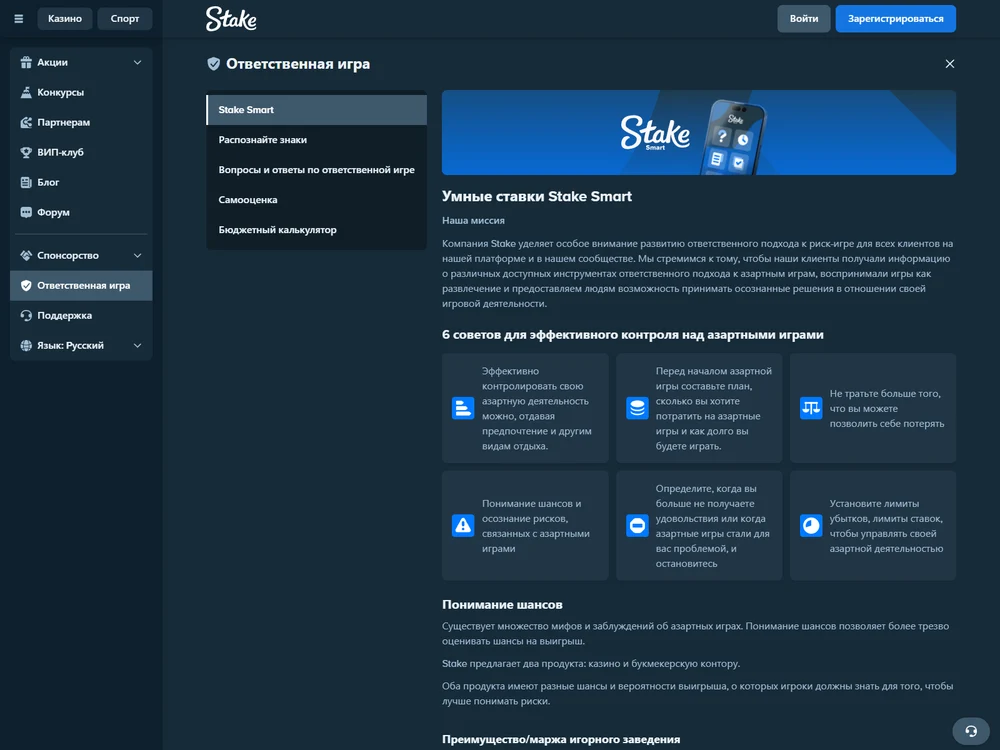
The figures in the table describe an individual profile and an illustrative session, not recommended spending for everyone. An amount one budget can afford may affect another person's essential expenses. Do not choose a limit based on the highest value in the form or how much a payment method allows you to deposit.
Net loss and the sum of all bets are not equal either.
When calculating the result, compare the starting bankroll and final balance while accounting for deposits and withdrawals, rather than adding up only losing rounds. Turnover, by contrast, counts accepted bets regardless of whether some money returned after settlement.
The day boundary matters for a daily limit. The profile shown uses Indian Standard Time, IST. This is a calendar period, not a promise that every deposit starts a new countdown of equal length. Read the period label in your account settings before confirming a change.
What happens to an already accepted bet
A session limit prevents the next entry after the accepted round is settled, but does not cancel an obligation that has already arisen. Reaching the loss threshold therefore cannot be understood as a guarantee of an exact final loss. The last result still has to reach the balance; the set limit does not automatically return lost money.
In the analytical example, the period is 30 minutes, including 6 minutes of breaks. That leaves 24 active minutes, or 1,440 seconds. At an assumed pace of 20 seconds per cycle, this gives 72 possible cycles; participation in 75% of them produces 54 accepted bets. At 20 INR each, they create turnover of 1,080 INR.
This calculation explains the difference between turnover, starting bankroll and losses without predicting outcomes or proposing a session plan: the pace is hypothetical. Once a loss of 300 INR or the time limit is reached, further entries stop and the already accepted bet proceeds to final settlement.
Cashout concerns the result of a specific game cycle. Frozen and the money cap also belong to the game mechanics; they do not become a ban on new deposits or an account block. The gross cap limits the payout according to its own rules, but does not add an automatic finish where none exists.
Set spending restrictions separately from game decisions.
If the connection drops, a vanished animation does not by itself prove that the round has ended. Open the history of the existing transaction and its final result. Do not place a new bet to test the connection: it increases your monetary involvement and does not establish what happened to the previous one. Bets and risk are covered in the risk management section.
How to lower a limit and end a session
Lower the restriction through account settings and check the confirmed value. In my profile, I immediately reduced the daily deposit limit from 2,000 to 1,500 INR and limited the session to 30 minutes. An increase in this profile has a 24-hour delay. This is a specific settings outcome, not a universal casino policy.
- Open the responsible gambling section in your operator account. Find deposits, losses, betting turnover and time separately: names and the available tools may vary.
- Choose the required period and reduce the relevant amount. Do not treat a number entered but not yet saved as an active restriction.
- Confirm the change and read the message about when it takes effect. Save the confirmation so you can distinguish an active limit from a pending request.
- Check the history of the already accepted round. After final settlement, stop entering further rounds even if the balance still allows a bet.
- If you need a longer stop, arrange a break or self-exclusion. Closing a tab does not replace an operator access restriction.
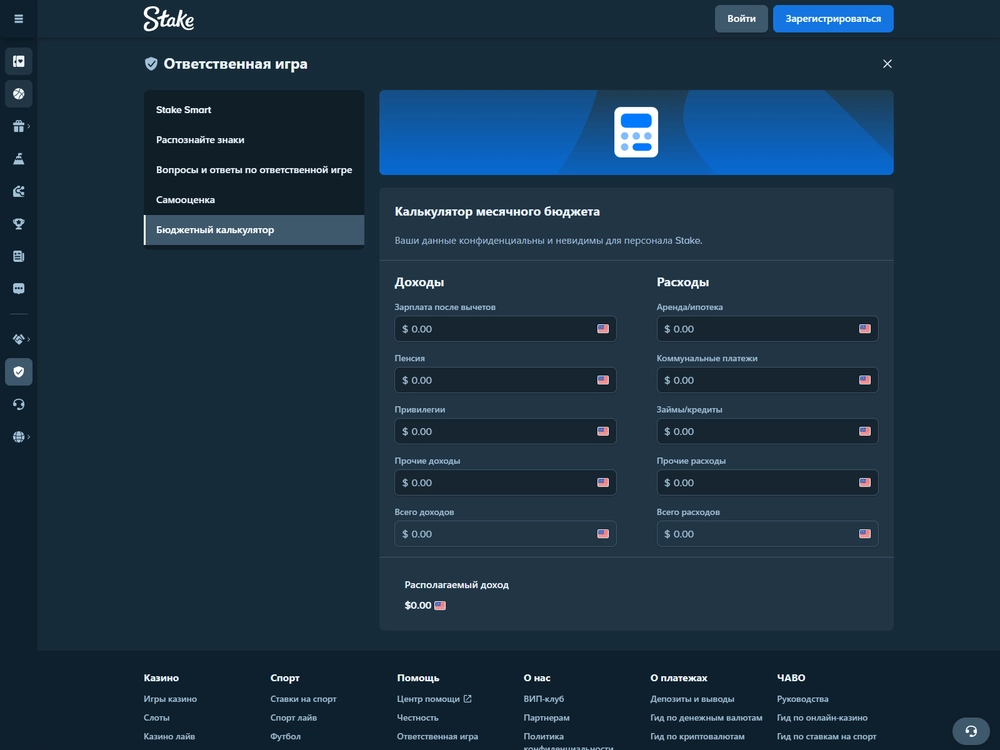
In the illustrative session, time in the background counts towards the total limit; minimising the app or switching tabs does not reset the timer. Use your own reminder as a signal to finish, not as an invitation to add a few more rounds before leaving.
The delay on increases creates a gap between the impulse to continue and relaxing the restriction.
Do not compensate for it with another account or payment method: that removes the very boundary you chose to set for yourself. Lowering a limit, by contrast, reduces the amount of participation available, so check when it takes effect separately from the rules for increases.
How a break differs from self-exclusion
A break temporarily restricts participation, while self-exclusion is intended to stop access for longer under a specific operator's terms. Ordinary account closure may have a different reopening procedure. In your request, explicitly name the required measure, its duration and the reason if it relates to losing control of gambling.
| Operator and scope of terms | Measure | Duration or effective time | Key feature |
|---|---|---|---|
| 1w | Self-exclusion through support | At least one year; effective immediately | No early reversal; funds deposited before the request can be withdrawn |
| Stake | Break | 24 hours, 48 hours, 7 days or 30 days | Login access for withdrawal remains available |
| MyStake | Self-exclusion by support email | From 6 months to 5 years; 6 months if no duration is selected | Differs from temporary account closure |
| Betify | Self-exclusion or cooling-off period | At least 6 months or 7 days respectively | No promotional materials are sent during self-exclusion |
| Parimatch | Self-exclusion | Request processed within 24 hours | Login and withdrawal are also blocked; the cooling-off period has a different scope |
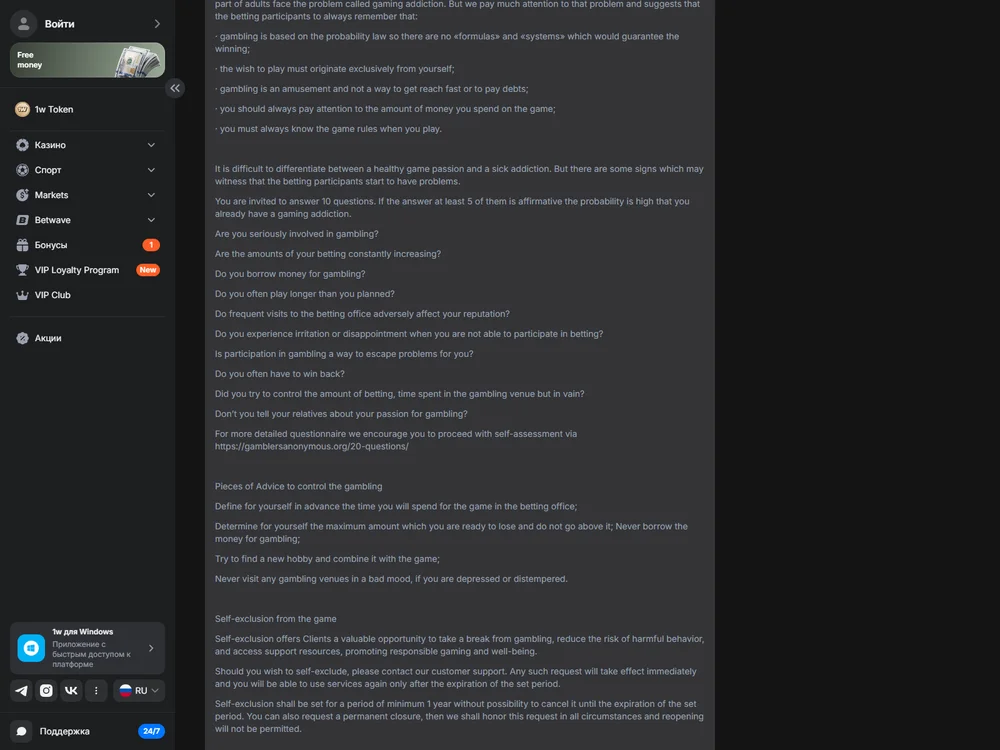
The table compares protective measures, rather than recommending places to gamble. The presence of such a tool does not establish Indian residents' right to register with an operator.
In particular, Betify's general terms prohibit registration from India; information about its restrictions helps explain the procedure but is not an invitation to open an account there.
1w and Stake: block duration and access to remaining funds
Under the 1w terms, self-exclusion lasts at least a year with no option to cancel it before the end. The request goes to support and takes effect immediately. Permanent closure is also available, after which reopening is not allowed. Do not confuse these options with simply logging out.
Funds held in the 1w balance before the request can be withdrawn.
This is not permission to continue betting during exclusion. If the main purpose of your request is to stop access, state that explicitly and separately clarify how the remaining balance will be handled. Do not delay the restriction to try to bring the balance to a more attractive amount.
At Stake, a break has several fixed durations and retains the ability to log in for withdrawal. There is also a restriction for an individual product: casino or sports betting. It can be temporary or indefinite. This measure does not close every form of participation, so check exactly which product the confirmation names.
Indefinite Stake self-exclusion is a separate option. Choosing a short break out of habit may not match an intention to stop access completely. Read the selected measure's name and terms in full; similar button placement in the responsible gambling section does not mean identical consequences.
MyStake and Betify: how to specify long-term exclusion
At MyStake, a self-exclusion request is emailed to support for a period from 6 months to 5 years. If no period is stated, the account is closed for 6 months. Temporary closure follows a different procedure: early restoration may be considered following a written request and the casino's decision. The wording of the request therefore matters.
Write that you are specifically requesting self-exclusion and state the chosen duration. If gambling problems are the reason, say so directly rather than using only a general phrase such as “close my profile”.
Save support's response: it lets you check the procedure applied, the set duration and any actions still required from you.
At Betify, the cooling-off period is 7 days and self-exclusion lasts at least 6 months. Promotional materials are not sent during self-exclusion. The terms also recommend requesting exclusion at other sites where you have accounts. A block with one operator is not an automatic blanket block of all your profiles.
Unsubscribing from advertising is useful as a separate action, but it is not self-exclusion: if betting access remains, financial participation technically continues. Check confirmation of the measure itself as well as the end of messages; do not create a new profile to bypass an existing restriction.
Parimatch: why withdrawal needs separate attention
Under the Parimatch terms cited, self-exclusion blocks deposits, bets, withdrawals and login. A cooling-off period works differently: deposits and bets are prohibited, but login and withdrawals remain available subject to the normal payout rules. Responsible gambling restriction requests are processed within 24 hours of receipt.
This distinction suggests a practical step: state both the need to stop gambling and the question of your remaining balance in the request. Do not assume you can enter the cashier yourself after every block. If access is already closed, contact support through the existing request rather than trying to bypass it with a new account.
Clarifying a payout does not require you to keep gambling.
Keep the enquiry number, confirmed status and payment request details. The external transfer procedure is described in the money withdrawals section, while document requests are explained on the verification page. Restricting access and checking a payout remain different procedures.
10 casinos: terms in detail
Brief facts from reviews of specific profiles. Game availability and conditions depend on the operator and account.

UPI · INR
- The Galaxsys original in the lobby.
- Android and web access on iPhone.
- Selected welcome offer: game contribution 0%.

USDT
- The Galaxsys original in the catalogue.
- Android: PWA without a separate APK.
- Selected welcome offer: game contribution 0%.

Visa · USD
- The original in the USD profile reviewed.
- Android app and browser on iPhone.
- Selected welcome offer: game contribution 0%.

UPI · INR
- One operator account for the game.
- UPI has its own limits.
- Cashout and external withdrawal are different actions.

UPI · INR
- The original is available on mobile.
- A fee was deducted in the withdrawal described.
- The welcome offer does not count stakes on this game.

UPI · INR
- Separate real-money and FUN modes.
- Android app and browser on iPhone.
- The welcome offer does not count stakes on this game.

INR
- The original and FUN mode are available.
- Android: APK; iPhone: web access.
- Selected welcome offer: game contribution 0%.

UPI · INR
- UPI in the app: from 100 INR.
- Minimum withdrawal for the selected route: 500 INR.
- The Aviator welcome offer does not count Tower Rush.

Restriction for India
- The general terms prohibit registration from India.
- Welcome offer: Shaolin Panda spins.
- The profile rating does not override restrictions.

UPI · INR
- The Galaxsys original in the operator account.
- UPI withdrawal includes a fee.
- Selected welcome offer: game contribution 0%.
When to stop and seek help
Stop playing for money if it affects essential expenses, forces you to borrow or keeps drawing you back to chase losses. Conflicts with loved ones, missed responsibilities and feeling unable to maintain your chosen limit independently are also reasons to seek support. Do not wait for a particular loss amount.
An operator's questionnaire should not become a diagnosis in itself or permission to continue; you do not need a specific number of positive answers to ask for help. If the question of control already worries you, you can discuss the situation and choose a restriction without first proving the problem's severity.
When talking to someone close to you, describe the specific difficulty: spending, hidden deposits, lost time or an inability to stop. Agree on a practical next step, such as sending an exclusion request. Asking for support does not require sharing an account password, bank details or verification codes.
Where to turn and how to protect shared access
Contact your operator to restrict an account; for support outside the casino, you can use GamCare, GambleAware or Gambling Therapy. Check the suitable channel, language and service territory on the selected organisation's website.
The Tower Rush India editorial team does not manage casino accounts and cannot apply self-exclusion to them. Editorial contacts are for questions about website content. Send a request to stop betting directly to the operator so that it reaches the team that actually controls access.
On a shared device, log out and do not leave an open account unattended. Do not save a password in a profile used by children. Keep user profiles separate. Block access to payment details. Parental control software can supplement these steps but does not replace logging out and protecting the device.
Do not allow minors to participate in betting or give them bank card details. An 18+ mark does not mean every site is permitted in every territory: the legal context depends on the relevant jurisdiction and operator.
Choose an action before the next bet
If you need to reduce spending, set separate deposit, loss and time limits. If maintaining them is difficult, move to a break or self-exclusion and seek support. Do not delay the request to chase losses or get one more result: stopping does not require ending the session in profit.
Questions about Tower Rush limits
Can Cashout replace a spending limit?
No. Cashout concerns the result of a particular round. It does not restrict subsequent deposits, total time or new bets. Responsible gambling settings and self-exclusion apply separately at operator account level.
Which matters more: deposits or net losses?
Limit them separately: deposits represent money paid in, while net losses represent a negative result over a chosen period. One measure does not replace the other. Also check betting turnover and session length if the relevant tools are available in your account.
Can I receive my remaining balance after self-exclusion?
The procedure depends on the operator and the chosen measure. The 1w terms allow withdrawal of an existing balance; a Stake break retains login access for withdrawal. Parimatch self-exclusion also blocks login and withdrawal, so ask support about receiving the remaining balance.
Do I need to wait for five positive questionnaire answers?
No. The number of answers should not serve as a diagnosis in itself or a condition for seeking help. If gambling affects money needed for essentials, relationships or your ability to stop, you can ask for support immediately.
Can Tower Rush India close my casino account?
No. This is an information project that does not accept bets or manage gaming wallets. Send requests for a break, self-exclusion or closure to your account operator.

About the author
Author: Karthikeyan Sengupta
Role: analyst of iGaming, Betting Sport and Gambling products
Experience: 7 years
Published: 4 November 2026
Devices: Realme 14 Pro+, Android 15, realme UI 6.0 / iPhone 15 Pro, iOS 26.5
Methodology: Assessment methodology