
 हिन्दी
 English


Why the original Tower Rush has different RTP figures
The different values relate to different configurations and listings for the original Galaxsys game, so they cannot be averaged into one “true” percentage. For readers in India, the practical reference is the parameters of the open INR real-money profile. The currency alone does not prove that every operator has identical limits.
| Mode | RTP | Stake | Payout limit per round |
|---|---|---|---|
| Provider demo in FUN | 96.17–97% | 1–100 FUN | 10,000 FUN |
| INR real-money configuration | 97% | 10–10,000 INR | 1,000,000 INR |
| MyStake USD | 97% | 0.10–100 USD | 10,000 USD |
| Betify EUR | 97% | 0.20–100 EUR | 10,000 EUR |
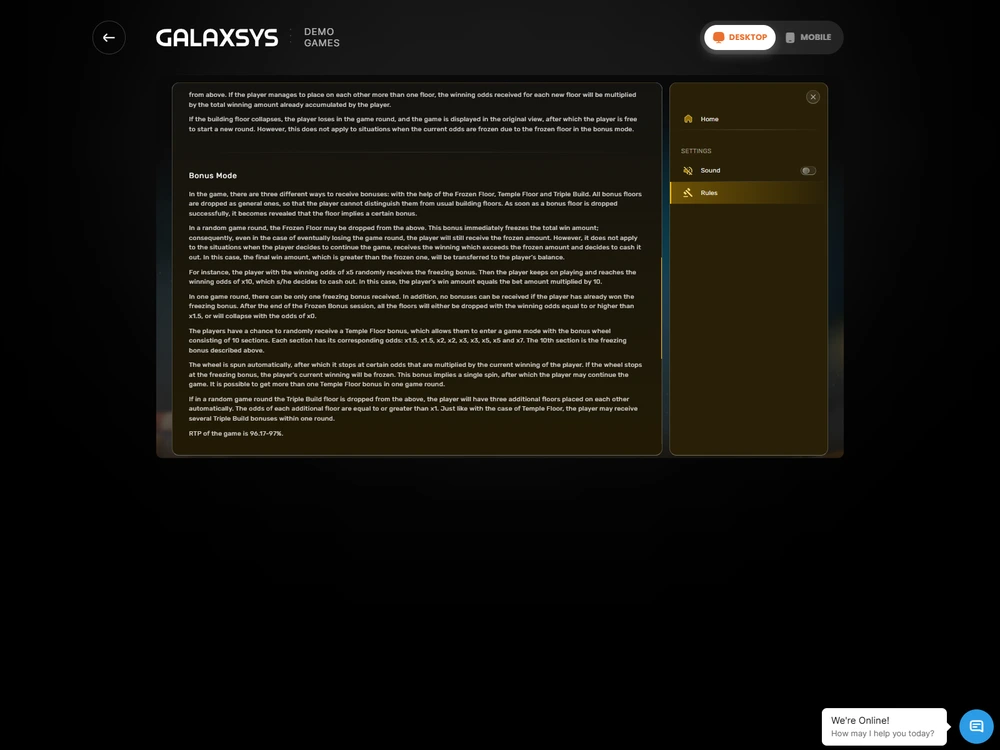
The Galaxsys listing describes a range of 96.2–97.6%, SlotCatalog gives 96.12–97%, and Casino Guru and Stake state 97%; each figure retains the scope of its respective listing and does not replace the parameters of an individual launch.
The Betify row describes a specific EUR profile. It is not a recommendation to register. The general terms prohibit registration from India. An individual gameplay episode does not override the territorial restriction or give an Indian reader a general right to open a new account.
In the INR configuration examined, changing the stake does not switch the RTP within the session. The Bet field sets the amount. It does not select a new return percentage. Raising the stake under the same mathematics increases the monetary exposure while retaining the house edge.
What the house edge means for a given turnover
The 3% edge applies to the sum of all comparable bets. It does not mean that 3% of the deposit must be deducted. For fixed turnover, multiply turnover by RTP to obtain the expected gross payout. Subtract turnover from that payout: the difference is the expected net result.
Why turnover is not the same as a deposit
Turnover is the sum of stakes, even when earlier payouts fund new rounds. A deposit only adds money to the wallet. The same amount can participate in several successive bets, so the deposit amount alone cannot determine the expected cost of the entire session.
To reconcile turnover, look at finally settled bets: an unused balance is excluded, while a new bet funded by a payout counts even without another deposit.
How to compare two return percentages
With the same turnover of 10,000 INR, 97% gives an expected net result of −300 INR, while 96.2% gives −380 INR. This compares mathematical expectations on an equal basis. An actual short session may end very differently, including profit or the loss of most of the allocated bankroll.
| RTP | House edge | Expected gross payout, INR | Expected net result, INR |
|---|---|---|---|
| 97% | 3% | 9,700 | −300 |
| 96.2% | 3.8% | 9,620 | −380 |
The RTP difference is 0.8 percentage points. The difference in expected losses is 80 INR, or 21.0526% relative to losses of 380 INR. These describe the same comparison in different ways: percentage points relate to RTP, while the relative percentage uses the chosen loss baseline. They are not interchangeable.
Even the higher of these RTP figures retains a negative expectation: the table explains the cost of equal turnover, but does not determine today's loss or the number of the final round.
10 casinos: terms in detail
Brief facts from reviews of specific profiles. Game availability and conditions depend on the operator and account.

UPI · INR
- The Galaxsys original in the lobby.
- Android and web access on iPhone.
- Selected welcome offer: game contribution 0%.

USDT
- The Galaxsys original in the catalogue.
- Android: PWA without a separate APK.
- Selected welcome offer: game contribution 0%.

Visa · USD
- The original in the USD profile reviewed.
- Android app and browser on iPhone.
- Selected welcome offer: game contribution 0%.

UPI · INR
- One operator account for the game.
- UPI has its own limits.
- Cashout and external withdrawal are different actions.

UPI · INR
- The original is available on mobile.
- A fee was deducted in the withdrawal described.
- The welcome offer does not count stakes on this game.

UPI · INR
- Separate real-money and FUN modes.
- Android app and browser on iPhone.
- The welcome offer does not count stakes on this game.

INR
- The original and FUN mode are available.
- Android: APK; iPhone: web access.
- Selected welcome offer: game contribution 0%.

UPI · INR
- UPI in the app: from 100 INR.
- Minimum withdrawal for the selected route: 500 INR.
- The Aviator welcome offer does not count Tower Rush.

Restriction for India
- The general terms prohibit registration from India.
- Welcome offer: Shaolin Panda spins.
- The profile rating does not override restrictions.

UPI · INR
- The Galaxsys original in the operator account.
- UPI withdrawal includes a fee.
- Selected welcome offer: game contribution 0%.
How gross payout and net result are calculated
Gross payout is the amount credited after a completed round. The net result also accounts for the cost. It subtracts the original stake from that credit. If 10 FUN is deducted and 15 FUN credited, the profit is 5 FUN; a credit of exactly 10 FUN returns the stake without earnings.
What Frozen Floor, Temple Floor and Triple Build change
Frozen Floor protects the locked amount within the same round and does not create a second payout on top of a successful exit. With a stake of 10 FUN, protection at 2× and an exit at 5×, the result is 50 FUN gross and 40 FUN net. Adding 20 FUN of protection to the 50 FUN exit to make 70 FUN is incorrect.
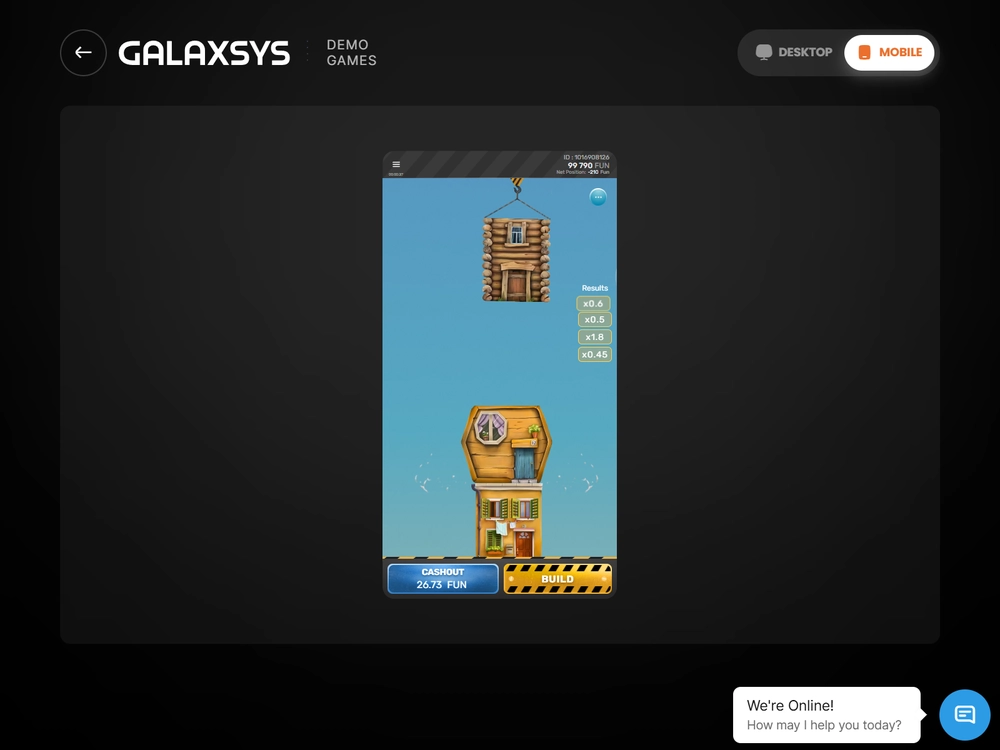
A fall after locking in that protection would produce 20 FUN gross. Subtracting the stake would leave 10 FUN net. The protection applies within a round already in progress. The next round requires its own stake and has a separate result; Frozen Floor does not create a separate risk-free deposit.
Temple Floor applies the resulting multiplier to the accumulated amount. For 15 FUN and a 3× segment, the result is 45 FUN. The wheel has ten segments with repeated values. The number of labels alone cannot determine payout probabilities: displayed options and the mathematical distribution are different characteristics.
Triple Build adds three floors without three new monetary debits. In the example starting with 10 FUN, the multipliers 1.2 × 1.25 × 1.6 produce an overall multiplier of 2.4× and a credit of 24 FUN. The net result is 14 FUN because the original 10 FUN is subtracted once.
To understand the buttons, use the game rules; for differences between bonus floors, use the Tower Rush features section. In your calculations, retain the key distinction between the deducted stake and the final credit.
Why the payout limit is not a universal 100×
A monetary cap limits the credited amount in a specific configuration, so a fixed limit cannot automatically be treated as the same multiplier for every stake. The demo has a maximum of 10,000 FUN. If the preliminary calculation produces 11,250 FUN, the credit is limited to 10,000 FUN.
Continuing after a limit warning does not grant the right to exceed the cap—neither 10,000 FUN in the demo nor the separate 1,000,000 INR per-round limit in the real-money profile.
At what stage the amount is rounded
The intermediate multipliers are multiplied first. The cap is then applied. The monetary gross payout is rounded half-up to 0.01 after the limit has been applied. Rounding each multiplier early may produce a different result, so reconciliation requires the complete sequence, not just the label for one step.
Half-up means rounding the retained digit upwards at an exact midpoint. This is a rule for representing money, not an additional source of return. Compare the final credit with a calculation in the same currency and precision; FUN, INR, USD and EUR cannot be added as though they were one monetary unit.
What a log of 16 settled cycles shows
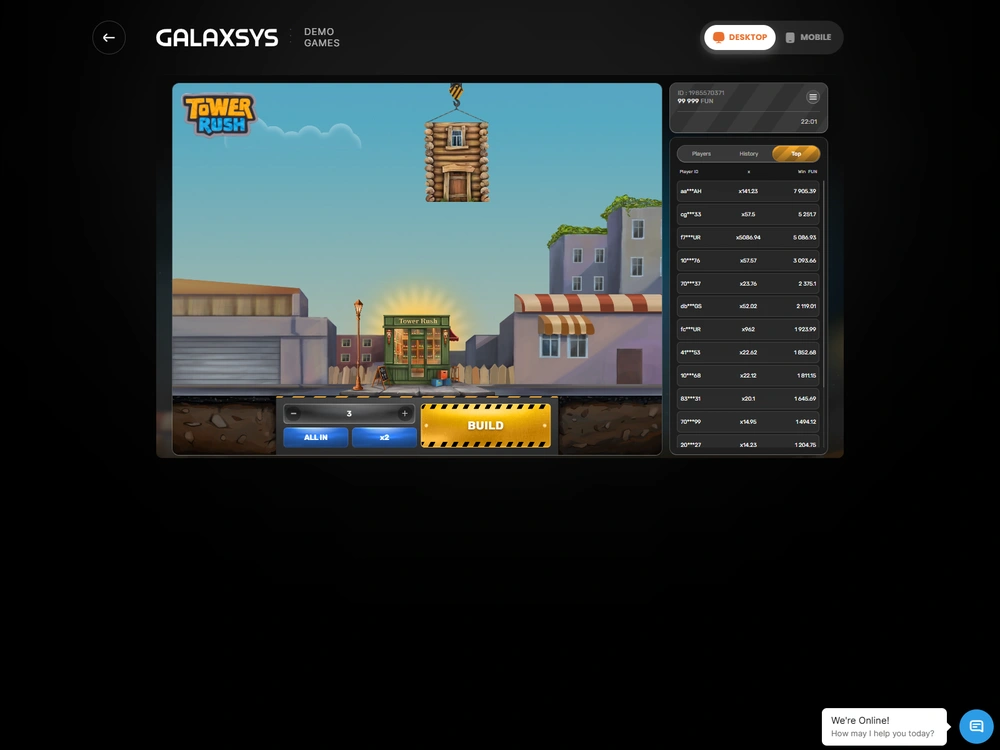
A short demo log shows the actual result of a specific sequence, not the engine's theoretical return. In my demo session, I started with 1,000 FUN and finished with 1,067 FUN. Of 17 accepted cycles, 16 were settled as gameplay, while one was cancelled with the stake refunded.
How to distinguish a cancellation from a win
The cancelled stake of 7.50 FUN was returned without profit. It is not included in betting turnover. Initial debits totalled 127.50 FUN; excluding the cancellation leaves turnover of 120 FUN. The return numerator includes 187 FUN in game payouts without adding the refund again.
Including the cancelled debit only in the denominator would understate the result. Adding the refund to winnings while excluding the stake would overstate it. First classify the transactions: settled round, cancellation with refund, top-up or demo balance reset. Then add comparable quantities.
| Metric | Calculation or value | What it measures |
|---|---|---|
| Turnover | 120 FUN | Stakes in 16 settled cycles |
| Gross game payouts | 187 FUN | Total credits excluding the refund |
| Net result | +67 FUN | Payouts minus turnover |
| Return on turnover | 187 / 120 = 155.8333% | Result weighted by stake amount |
| Mean of payout-to-stake ratios | 136.25% | Result with equal weight for each cycle |
| Positive payout | 9 / 16 = 56.25% | Share of cycles with gross above zero |
| Profitable cycles | 8 / 16 = 50% | Share of cycles with net above zero |
| Bonus events | 4 / 16 = 25% | Frequency in this sequence |
| Sample variance of net results | 174,695833 FUN² | Spread of net results, denominator 15 |
| Standard deviation of net results | 13.217255 FUN | Spread in demo currency units |
| Maximum drawdown | 10 FUN | Decline from the peak settled balance |
Why the two averages differ
The return of 155.8333% weights each outcome by the stake amount, whereas 136.25% gives each cycle equal weight. Stakes varied in the log, so averaging ratios and taking the ratio of totals answer different questions. For money movements, use the second approach: divide total payouts by total turnover.
When individual ratios are averaged, the same relative result receives the same weight regardless of stake size; monetary return, by contrast, depends more heavily on outcomes from larger stakes.
What spread and drawdown mean
Sample variance describes the spread of net results around the mean in this log, while drawdown describes the balance's fall from a previously reached high. These are different properties of the sequence. Here, variance is calculated with the denominator n−1, or 15, and expressed in FUN²; standard deviation returns to familiar FUN units.
The drawdown of 10 FUN across settled balances and the maximum credit of 50 FUN describe only this log. They set neither a guaranteed limit on future losses nor a ceiling for the product.
After finishing, I opened a new demo session with 1,000 FUN. The difference of −67 FUN between the new starting balance and the previous remainder is a reset, not a lost round. FUN cannot be withdrawn externally: demo profit cannot be treated as withdrawable rupees or earnings in a real-money account.
Why payout frequency is not the probability of profit
A positive payout does not necessarily mean profit: a credit may simply return the stake. In the log, 9 cycles produced gross above zero, but only 8 had positive net results. One more returned exactly the amount staked. The figures 56.25% and 50% therefore cannot be used interchangeably.
For the positive-payout share of 9 out of 16, the 95% Wilson interval is 33.179–76.901%. It shows the statistical uncertainty in estimating frequency from a short sample. It is not an RTP interval, the probability of the next floor, or a promised range for a future session's result.
Four bonus events give a sample frequency of 25%: two Frozen Floor events, one Temple Floor and one Triple Build. This does not mean a bonus must arrive every fourth round. A sequence of observations does not set an event schedule or prove that compensation is approaching after a loss.
Where mathematical conclusions end
RTP defines the average monetary return, but this number alone is insufficient to reconstruct the outcome distribution. Games with the same expectation may differ in payout frequency, spread of results and depth of drawdowns. A figure of 97% does not independently provide a formula for the probability of a successful Build.
In a separate analytical two-outcome model, a 2× payout with probability 0.485 and a zero payout with probability 0.515 give an expectation of 0.485 × 2 = 0.97 of the stake. This illustrates the meaning of RTP. It does not reproduce the floors, Frozen Floor, Temple Floor or multiplier distribution of the original game.
This model helps explain why the share of profitable sessions can rise without a positive mathematical expectation: rare large losses can outweigh more frequent small wins. Stopping rules and stake changes affect the distribution and turnover, but do not prove that earnings are possible. Details are covered in risk management.
A matching gross/net calculation confirms the arithmetic of a credit, but does not reveal a future outcome; the origin of a random result is discussed separately under result verification.
How to use the calculations before a session
Use mathematics to assess spending and reconcile credits, not to choose the moment of an “inevitable” win. Higher RTP at equal turnover reduces expected losses but does not eliminate them. A positive demo result is not a reason to increase a real-money stake or try to recover previous losses.
- Open the rules of the current launch and compare the currency, RTP, stake range and payout limit.
- Separate the budget allocated for entertainment from anticipated turnover; do not treat the deposit as the only calculation base.
- When reconciling the history, separate the stake, gross credit, net result and cancelled transactions.
- Compare results only within one configuration and currency; for money, use a real-money log rather than FUN.
- Stop playing when you reach your personal limit, without expecting the next payout to restore the balance.
Questions about RTP and payouts
Can RTP reveal the chance of the next floor succeeding?
No. RTP describes the expected monetary return, while the probability of an individual floor requires its own distribution parameters. A value of 97% does not mean a 97% chance of a successful Build.
Does 97% mean a return of my specific deposit?
No. The expectation relates to betting turnover, which may differ from the deposit. It does not promise to return a fixed share of your money in an individual session.
Why was the demo session's return above 100%?
A short sequence can end in profit. In the log examined, payouts of 187 FUN on turnover of 120 FUN produced 155.8333%. This is the result of that sample, not a new RTP for the engine.
Is the payout limit always 100×?
No. The cap is a monetary amount for a specific configuration: for example, 10,000 FUN in the demo and 1,000,000 INR in the real-money profile described. A fixed amount is not a universal multiplier for every stake.
Does the stake size change the selected RTP?
In the INR profile examined, changing the stake does not switch the RTP within a session. At the same return percentage, greater turnover increases the monetary value of expected losses.

About the author
Author: Karthikeyan Sengupta
Role: analyst of iGaming, Betting Sport and Gambling products
Experience: 7 years
Published: 4 November 2026
Devices: Realme 14 Pro+, Android 15, realme UI 6.0 / iPhone 15 Pro, iOS 26.5
Methodology: Assessment methodology